Bingo Jackpot Payouts Explained: Calculate RTP, Odds, and Progressive Jackpot Potential
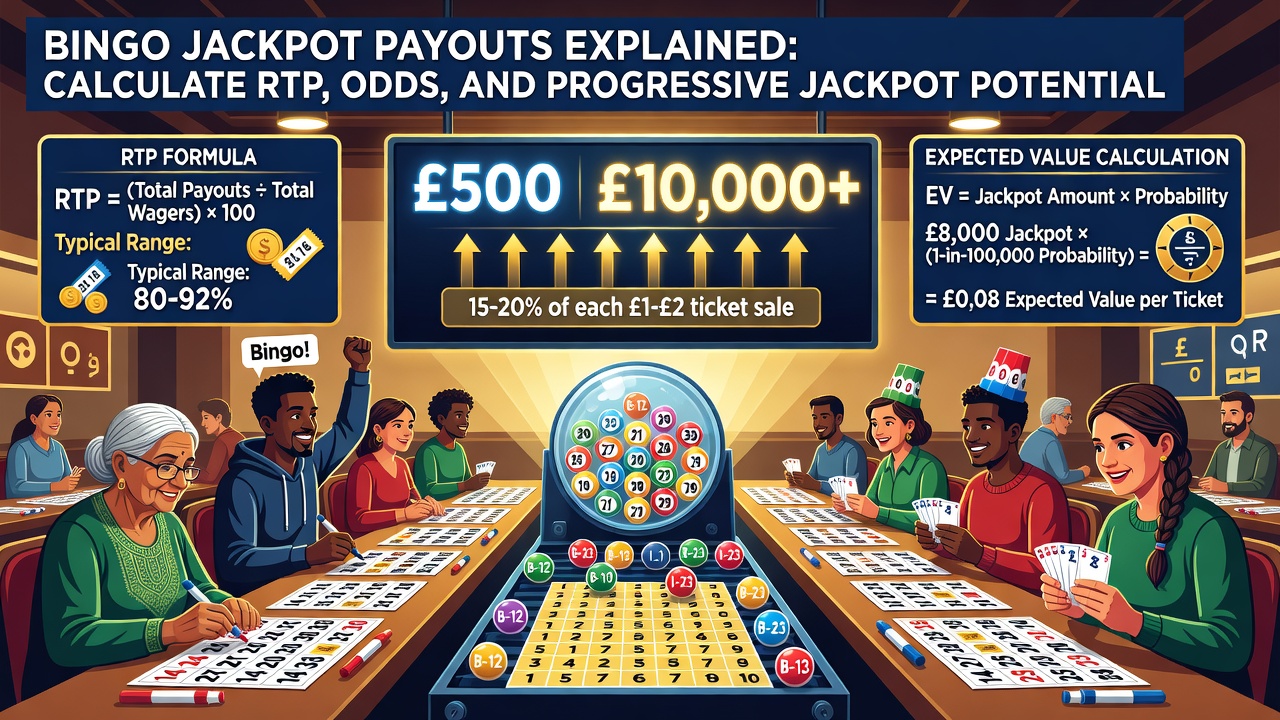
A £10,000 bingo jackpot sitting behind a one-in-4-million card draw is not the same bet as a £500 jackpot behind a one-in-50,000 draw, yet most players treat every jackpot line the same way: as a number to chase. The math tells a different story, and once you know how to read it, the whole game changes shape.
Bingo rooms rarely publish their full payout tables in plain language, so players are left guessing at how a jackpot is funded, how often it actually pays, and what portion of their stake returns to them over time. This gap between marketing and mechanics is where informed players gain an edge. Some operators make the underlying math easier to inspect than others, and platforms such as the one behind this link have started presenting jackpot structures with more transparency than the industry average, which is a useful reference point when you're learning to read these numbers yourself.
This piece breaks down the arithmetic behind jackpot bingo payout structures, shows you how to run your own bingo RTP calculator estimates, and explains why progressive bingo jackpot pools behave so differently from fixed prizes. By the end, you'll be able to look at a jackpot advertisement and know, within reason, whether it's a good bet or a marketing hook.
What Determines a Bingo Jackpot Payout
A jackpot bingo payout is not a fixed gift from the operator. It's a redistribution of money already collected from players, structured to create excitement while keeping the house's margin intact. Understanding the mechanics behind that redistribution is the first step toward evaluating whether a jackpot game is worth your stake.
Ticket Price and Prize Pool Relationship
Every bingo jackpot pool draws from ticket sales. Operators typically allocate a fixed percentage of each ticket price into the jackpot fund, while the remainder covers standard game prizes, operating costs, and profit margin. A game with a £1 ticket price and a 20% jackpot contribution builds its pool at a predictable rate tied directly to player volume. Higher ticket volume means faster jackpot growth, but it also means more players splitting the eventual win.
Fixed vs Variable Jackpot Structures
Fixed jackpots pay a set amount regardless of how many tickets sold or players participated. Variable jackpots scale with room activity, sometimes capped, sometimes not. Fixed structures offer predictability; variable ones offer upside during high-traffic sessions but shrink during quiet ones. Neither is inherently better - the right choice depends on whether you value consistency or ceiling potential.
Number of Calls Required to Win
Most jackpot bingo games attach a "win by call number" condition - for example, a full house achieved within 40 calls or fewer. This single variable does more to shape your realistic odds than almost anything else in the game. Fewer required calls mean a rarer, more valuable win; more calls allowed mean a higher chance of hitting the jackpot but usually a smaller prize pool per winner, since the condition is easier to satisfy.
- Jackpot contribution rate per ticket
- Whether the structure is fixed or variable
- Maximum calls allowed for a qualifying win
- Number of cards in play per session
How to Use a Bingo RTP Calculator
Return to player figures are the clearest single indicator of how a game treats its players over the long run, and jackpot bingo games often report RTP differently than standard slot or table games because of the added jackpot variable.
Understanding the RTP Formula
Bingo return to player is calculated as the total amount paid out to players divided by the total amount wagered, expressed as a percentage, measured across a large number of game rounds. A standard bingo room might report an RTP of 90%, meaning that for every £100 wagered across all players over time, £90 returns as prizes. The remaining £10 covers the operator's margin. Jackpot games complicate this figure because the jackpot itself is a rare, large payout that skews short-term results but averages out over a long enough sample.
Inputting Ticket Price, Prize Pool, and Frequency
A bingo RTP calculator needs three core inputs: average ticket price, average prize pool size including jackpot contribution, and expected frequency of jackpot hits. Plug these into a basic formula - total expected payouts divided by total expected wagers - and you get a working RTP estimate. Most calculators also let you separate the base game RTP from the jackpot-inclusive RTP, which matters because the jackpot portion carries far more variance than the standard prize structure.
Interpreting the Output for Real Decisions
An RTP of 88% doesn't mean you'll get back 88 pence for every pound you spend in a single session. It means that across thousands of rounds, that's the average return. For jackpot games specifically, a high headline RTP paired with a rarely-hit jackpot can mean long stretches of losses punctuated by one large win - a variance profile you should factor into your bankroll planning rather than your expectation of steady returns.
Understanding Bingo Jackpot Odds
Odds and RTP measure different things. RTP tells you the average financial outcome; odds tell you the probability of the specific event - hitting the jackpot - actually happening during your session.
Card Count and Probability Basics
The number of cards you hold directly affects your bingo jackpot odds. Holding two cards roughly doubles your chance of matching the winning pattern compared to holding one, assuming all cards are equally likely to be drawn against the same call sequence. This relationship is linear at low card counts but the marginal benefit of adding more cards shrinks as room size and total cards in play increase, since your share of the total probability pool stays proportionally the same.
Pattern Complexity and Win Frequency
A full house requirement produces far longer odds than a single line. Jackpot games layered with a call limit - win within a set number of calls or the jackpot rolls over - add a further constraint. The tighter that call limit, the longer the true odds, even if the advertised jackpot figure looks identical to a looser-limit game elsewhere.
Comparing Odds Across Different Bingo Rooms
Two rooms can advertise the same £5,000 jackpot with wildly different real odds depending on room size, card saturation, and call limits. A smaller room with fewer active cards gives each player a statistically larger slice of the probability, even though the total prize pool might be smaller. Comparing rooms on jackpot size alone, without factoring in player count and call conditions, is one of the most common mistakes casual players make.
Progressive Bingo Jackpot Mechanics
A progressive bingo jackpot behaves differently from a fixed prize because it grows continuously, funded by a small percentage of every ticket sold across potentially multiple linked rooms or platforms, until someone meets the win condition.
How the Jackpot Pool Grows Over Time
Each ticket purchase feeds a small contribution into the progressive pool. Unlike a fixed jackpot that resets to a base value after each win, a progressive pool keeps accumulating across sessions, sometimes days or weeks, until a qualifying win occurs. This creates the escalating jackpot totals players see climbing on room displays - the longer the jackpot goes unclaimed, the larger and more attractive it becomes to new players, which in turn accelerates its growth further.
Networked vs Standalone Progressive Jackpots
Standalone progressives grow from a single room's ticket sales alone. Networked progressives pool contributions from multiple rooms or even multiple platforms, growing far faster and reaching much larger totals, but also splitting the probability pool across a much larger player base. A networked jackpot might look more attractive on paper, but your individual odds of being the one to claim it are correspondingly longer.
Why Larger Jackpots Mean Longer Odds
There's a direct trade-off between jackpot size and win probability in progressive structures. The mechanism that allows the pool to grow - an unclaimed, hard-to-reach win condition - is the same mechanism that keeps your odds long. A jackpot that grew to six figures did so precisely because it's difficult to win. Recognizing this trade-off prevents the common error of treating a large jackpot number as evidence of good value.
Calculating Your Real Expected Value
Expected value combines everything covered so far - RTP, odds, ticket cost, and jackpot size - into a single number that tells you whether a specific jackpot bet is mathematically favorable at the moment you're considering it.
Combining RTP, Odds, and Ticket Cost
Expected value equals the probability of winning multiplied by the payout, minus the ticket cost multiplied by the probability of not winning. For jackpot games, run this calculation using the current jackpot size, not an average or historical figure, since progressive jackpots change in value daily. A jackpot that has grown unusually large relative to its typical hit frequency can produce a temporarily favorable expected value, even in games with otherwise modest base RTP.
Session-Based vs Long-Term Value Estimates
A single session's expected value tells you little on its own because jackpot wins are rare, high-variance events. Long-term value estimates, run across dozens or hundreds of sessions, smooth out that variance and give a more reliable picture of whether a particular jackpot game format consistently favors the player or the house.
Practical Example Walkthrough
Consider a room selling £2 tickets, contributing 15% of each sale to a progressive jackpot currently sitting at £8,000, with roughly a 1-in-100,000 chance of any single ticket triggering the win condition. Multiply the payout by the probability: £8,000 × 0.00001 equals £0.08 in jackpot-derived expected value per ticket. Add the base game's expected return - say, another £1.60 from standard prizes on a £2 ticket - and the total expected value sits at £1.68, below the £2 stake. This is typical; the house edge exists precisely so the operator remains sustainable, and the jackpot component alone rarely closes that gap.
- Current jackpot size, checked in real time
- Estimated hit probability based on call limits and card count
- Base game RTP excluding the jackpot
- Ticket cost and session bankroll
Reading Jackpot Terms and Conditions Correctly
The fine print on jackpot bingo games often contains the details that most affect your actual odds and payout, yet it's the section players skip most often.
Rollover Rules and Caps
Some progressive jackpots cap at a maximum value; once reached, further contributions either stop or divert to a secondary prize pool. Others roll over indefinitely. Knowing whether a jackpot is near its cap matters because a capped jackpot approaching its ceiling offers no further upside even as more tickets sell, changing the expected value calculation.
Split Jackpot Scenarios
When multiple players qualify for a jackpot in the same round - a realistic scenario in full-house games with generous call limits - the prize typically splits evenly among winners. This detail rarely appears in headline advertising but can cut your effective payout significantly in high-participation rooms.
Eligibility Requirements Players Often Miss
Minimum stake thresholds, specific card purchases, or participation windows can all disqualify an otherwise winning card from jackpot eligibility. Always confirm that your ticket purchase actually qualifies for the jackpot pool before assuming a win entitles you to the full advertised amount.
Frequently Asked Questions
What's a realistic RTP range for jackpot bingo games?
Most licensed jackpot bingo games report RTP figures between 80% and 92%, with the jackpot-inclusive figure often running slightly lower than the base game RTP due to the added variance. Always check whether the published RTP includes or excludes the jackpot contribution before comparing rooms.
Does buying more cards actually improve my jackpot odds meaningfully?
Yes, proportionally - two cards roughly double your odds compared to one, assuming equal card distribution. However, the improvement is linear, not exponential, so doubling your spend doubles your odds but also doubles your risk exposure per session.
Why do progressive jackpots sometimes reset to a low starting value?
Once a progressive jackpot is won, most structures reset the pool to a predetermined base value, called the seed amount, and begin accumulating again from there. This is standard practice and doesn't indicate anything unusual about the room's payout structure.
Can I trust the jackpot size shown on the display as accurate in real time?
Reputable operators update jackpot displays continuously or near-continuously as tickets sell, but brief lag is normal. If you're calculating expected value for a time-sensitive decision, refresh the page or app immediately before finalizing your calculation.
Is a smaller room with lower jackpots ever a better bet than a large networked progressive?
Often, yes. Smaller rooms typically have fewer cards in play, which improves your individual odds even though the total prize is lower. Running the expected value calculation for both room types usually shows the smaller room offering a more favorable ratio between stake and realistic win probability.
How often should I recalculate expected value while playing a session?
Recalculate whenever the jackpot size changes significantly or after every few rounds if you're tracking a progressive pool closely. Since progressive jackpots grow with each unclaimed round, your expected value shifts incrementally, and periodic recalculation keeps your betting decisions grounded in current numbers rather than outdated ones.