Sic Bo House Edge Explained: Sic Bo Odds, Game Probability, and Practical Ways to Reduce House Edge Using Strategy Odds
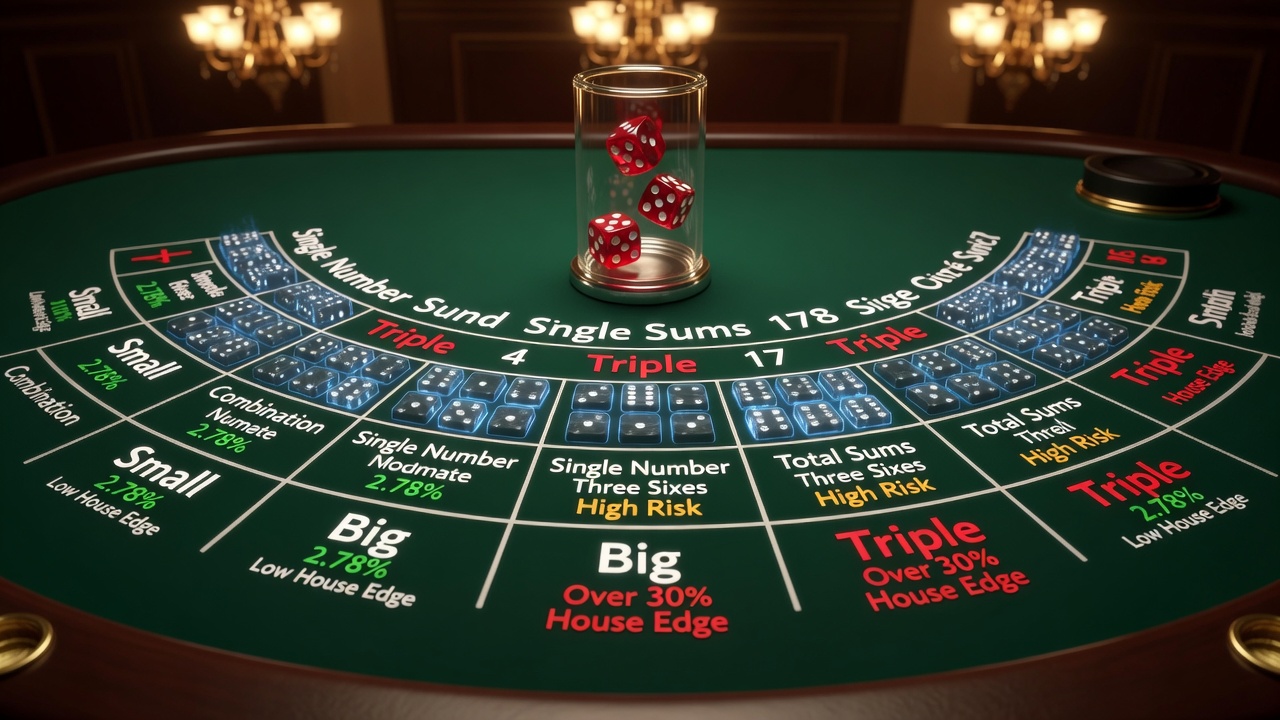
Roll three dice, place a bet, and the casino has already decided how much of your money it expects to keep before you ever pick up the cup. That number ranges from under 3% to over 30%, depending entirely on which bet you choose. Few casino games display such a wide spread between their best and worst wagers, and almost no other game rewards a basic understanding of probability quite as directly.
Sic Bo looks chaotic on the surface - three dice, dozens of betting spots, a table diagram that resembles a control panel more than a card layout. But underneath that complexity sits a rigid mathematical structure. Every bet corresponds to a fixed payout and a fixed probability, and the gap between those two numbers is where the casino's advantage lives. Readers looking for a full statistical rundown of every wager, including verified payout ratios and probability tables, can consult the detailed breakdown on sic bo house edge, which lays out the numbers bet by bet. That resource pairs well with the strategic reasoning covered here.
This piece breaks down exactly how Sic Bo odds are calculated, why certain bets drain bankrolls faster than others, and which decisions - grounded in real casino game probability - actually shift the numbers in your favor. None of this requires luck. It requires knowing which bets to avoid and why.
Understanding Sic Bo as a Game of Probability
Sic Bo is a dice game built on three standard six-sided dice, shaken either mechanically or by hand inside a covered container. Once the dice settle, the outcome triggers payouts across a betting grid that ranges from simple even-money wagers to specific triple combinations. Unlike card games where prior draws affect future odds, each roll of the dice is fully independent. There is no memory in the system, no pattern to track, no sequence that increases predictive power.
How the Three Dice Create the Odds Structure
Three dice produce 216 possible combinations (6 x 6 x 6). Every bet on the table maps to a specific subset of those 216 outcomes. A Big or Small bet, for instance, covers roughly half of all possible combinations, which is why its payout sits close to even money. A specific triple, by contrast, matches only one exact outcome out of 216, which explains why its payout climbs dramatically higher. This direct relationship between outcome count and payout size is the entire mathematical skeleton of the game.
Why Payouts Rarely Match True Odds
If payouts matched true probability exactly, the game would have no house edge and casinos would earn nothing from offering it. Instead, every payout is set slightly - or dramatically - below what pure mathematics would justify. A bet with a 1-in-6 chance of winning might pay out at odds equivalent to 1-in-5, and that shortfall is the house's built-in profit margin. Recognizing this gap for each bet type is the single most useful skill a Sic Bo player can develop.
Breaking Down Sic Bo Odds Bet by Bet
Not all Sic Bo bets are created equal, and the differences are not subtle. Some wagers keep the house advantage in low single digits, while others push past 30%. Knowing where each bet falls on that spectrum changes how a player should approach the table entirely.
Small and Big Bets
These wagers bet on whether the sum of the three dice falls into the "small" range (4-10) or "big" range (11-17), excluding triples from both categories. They carry close to even odds and typically produce one of the lowest house edges on the table, making them a natural starting point for anyone prioritizing sustainability over big payouts.
Single Number Bets
A single number bet wins if the chosen number appears on one, two, or three of the dice, with payouts scaling based on how many dice show that number. The probability is more favorable than many players assume, and the house edge here sits in a moderate, reasonable range.
Combination and Total Bets
Combination bets require two specific numbers to appear together on any two dice, while total bets wager on the exact sum of all three dice. Totals near the middle of the range (10 or 11) have more combinations backing them and therefore better odds than totals near the extremes (4 or 17), which occur through far fewer dice combinations.
Triple and Specific Triple Bets
These are the highest-risk, highest-reward wagers on the table. A specific triple - say, three sixes - has only one winning combination out of 216. The payout is large, but the probability is so thin that the house edge on this bet is among the steepest in the entire casino, not just within Sic Bo.
- Small/Big: lowest house edge, close to even-money structure
- Single Number: moderate edge, forgiving for beginners
- Combination: moderate-to-high edge depending on the pairing
- Total (extreme sums): high edge due to rarity of outcome
- Specific Triple: highest edge on the table by a wide margin
Calculating the Sic Bo House Edge
The house edge on any bet is calculated by comparing the payout offered against the true statistical probability of winning. The formula strips away the excitement of the dice and reduces the game to pure arithmetic: expected loss per unit wagered, expressed as a percentage.
The Formula Behind the Numbers
House edge is derived by multiplying the probability of losing by the amount lost, multiplying the probability of winning by the amount won, and summing the results. When the sum is negative from the player's perspective - which it always is in a properly run casino game - that negative percentage represents the house's long-term edge on that specific bet.
Why the Edge Varies So Much Between Bets
Because Sic Bo offers such a diverse menu of bets with wildly different probability structures, the house edge is not a single fixed number the way it might be in a simpler dice game. It is a spectrum. This is unusual among casino games and gives Sic Bo a reputation for being unforgiving to players who bet impulsively across high-payout options without checking the underlying math first.
Comparing Sic Bo to Other Casino Games
Placed next to roulette, craps, or baccarat, Sic Bo's best bets are competitive, sitting in a similar range to a standard roulette wheel. Its worst bets, however, rival some of the poorest-value wagers found anywhere in a casino, including certain proposition bets in craps. This dual identity - reasonable on one end, punishing on the other - makes bet selection the deciding factor in long-term results.
Practical Ways to Reduce House Edge
Sic Bo cannot be beaten in the mathematical sense - no betting system alters the independent probability of dice - but the house edge a player actually experiences is not fixed. It shifts dramatically based on bet selection, discipline, and bankroll structure.
Prioritize Low-Edge Bets
Consistently choosing Small, Big, or single number bets keeps the average house edge low across a session. This does not guarantee winning, but it slows the rate of expected loss significantly compared to chasing triple payouts.
Avoid Stacking High-Edge Bets Simultaneously
A common mistake is spreading chips across multiple triple and combination bets at once, assuming variety increases the odds of hitting something. In reality, this only increases the average edge faced per roll, since each additional high-edge bet compounds the expected loss rather than offsetting it.
Set Session Limits Based on Bet Type
Players who mix bet types should adjust their loss limits accordingly. A session built around low-edge bets can sustain longer play with a smaller bankroll, while a session leaning on high-payout triples should be budgeted as entertainment spending, not as a strategy expected to break even.
Track Bet Performance Over Time
Keeping a simple record of which bets were placed and their outcomes over multiple sessions reveals patterns in personal betting behavior - often showing that a disproportionate amount of losses comes from a small number of high-edge bets placed out of impulse rather than calculation.
Sic Bo Strategy Odds: What Actually Works
Strategy in Sic Bo is less about predicting dice and more about structuring bets to align with favorable casino game probability. This distinction separates disciplined players from those relying on superstition.
Flat Betting on Low-Edge Wagers
Placing consistent, equal-sized bets on Small/Big or single numbers avoids the trap of escalating bets after losses, a pattern that increases exposure without improving actual odds.
Combining Bets for Balanced Risk
Some experienced players pair a low-edge bet with a small, calculated stake on a higher-payout option, treating the second bet as a capped-risk addition rather than a primary strategy. This keeps the overall session edge manageable while preserving a chance at a larger payout.
Why Progressive Betting Systems Fall Short
Systems like Martingale, which double bets after a loss, do not change the underlying probability of any single roll. Applied to Sic Bo's higher-edge bets, they accelerate losses faster than they recover them, since the house edge compounds with every additional wager rather than resetting.
Frequently Asked Questions
What is the lowest house edge bet in Sic Bo?
Small and Big bets typically carry the lowest house edge on the table, since they cover roughly half of all possible dice outcomes and pay close to even money. They are the most statistically forgiving option for players prioritizing longevity over big payouts.
Why do triple bets have such high payouts?
A specific triple bet wins on only one combination out of 216 possible dice outcomes, making it extremely rare. The high payout compensates for that rarity, but the payout still falls short of the true odds, which is why the house edge on triples is among the highest in the game.
Can betting systems reduce the Sic Bo house edge?
No. Betting systems change the size and timing of wagers, not the independent probability of each dice roll. The house edge on each bet type remains fixed regardless of how bets are staked or sequenced.
Is Sic Bo better or worse than roulette in terms of odds?
It depends entirely on which bets are chosen. Sic Bo's best bets are comparable to standard roulette wagers, but its worst bets carry a significantly steeper house edge than anything found on a roulette table.
Does the number of dice rolled affect the odds calculation?
Yes. All Sic Bo odds are calculated based on the 216 possible outcomes from three independent six-sided dice. Every bet's probability and corresponding house edge derive directly from how many of those 216 combinations satisfy the bet's winning condition.
What is the single most effective way to reduce losses in Sic Bo?
Concentrating bets on low-edge options like Small, Big, or single numbers, while avoiding triples and extreme totals, is the most reliable way to lower expected losses over time. This approach does not eliminate the house edge but minimizes its impact across a session.